
Is It Too Late to Learn Piano as an Adult?
Is it too late to learn piano as an adult? No. Adults start piano at every age, and many others come back to it after years away. Here is why it is not too late, what adults bring to the piano, the worries that come up most and what helps, and what the first months look like.
Why it is not too late
Your brain keeps adapting to practice at every age. Scientists call this neuroplasticity, and research shows the brain keeps changing with learning and training through adulthood. A review of studies on aging found that older adults could pick up new movement skills to an extent similar to younger people. In one study, adults aged 60 to 85 who had never played music took individual piano lessons for six months, and they did better on tests of thinking skills than a group without lessons. We find that for most adults the main limit is time, not ability. At All Around Music, our teachers work with adult beginners and returning players, and you can read more on our page for online music lessons for adults.
What adults bring to the piano
Adults bring strengths of their own. You choose the music you want to play, and many adults pick up note names, reading and chords quickly. If you have sung in a choir or played another instrument, that gives you a head start. You can also set your own goals and plan practice around your week. One thing is different, though. No one reminds an adult to practice, so it helps to tie practice to something you already do every day.

Common worries, and what helps
A few worries come up again and again with adult beginners. Your hands may not want to work together at first, and reading may feel slow. A song can take several weeks to learn, which is normal. When time is short, a short practice on most days keeps you moving. Some days a piece feels worse than the day before, and progress can be happening even when you do not notice it. Playing for someone else, your teacher included, can make your hands shaky, and that happens to experienced players too. Mistakes are part of learning, so let one wrong note go and keep the beat moving.

Set up to play
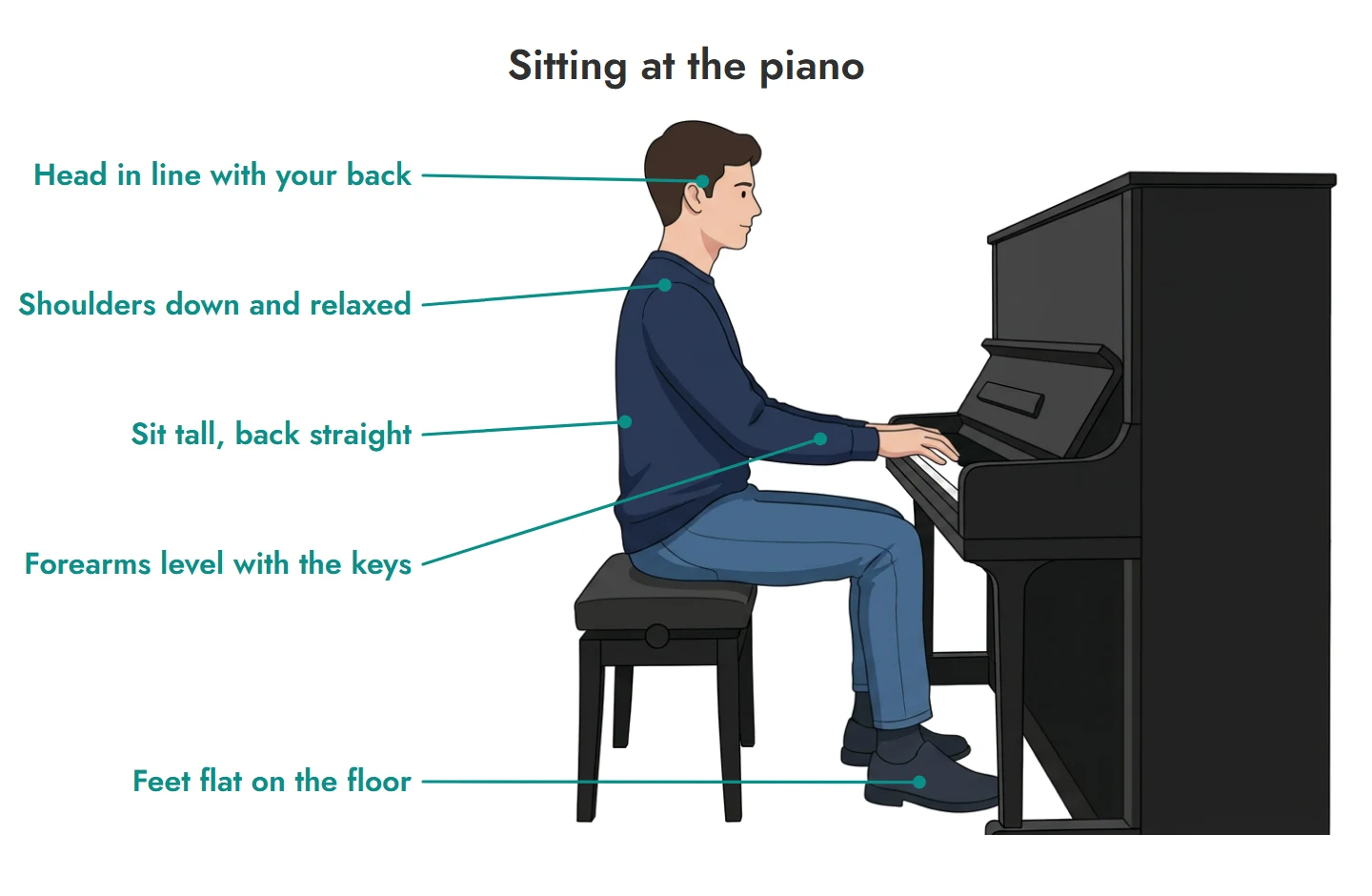
Sit tall near the front of the bench, at a height where your elbows are about level with the keys. Sitting a little high is better than too low, and a firm cushion can help. Keep your shoulders relaxed, your fingers gently curved and play near the fingertips. A minute of warm up, such as five fingers up and down a few keys, gets your hands ready. For more, see how to sit and hold your hands at the piano.
Find your way around the keys
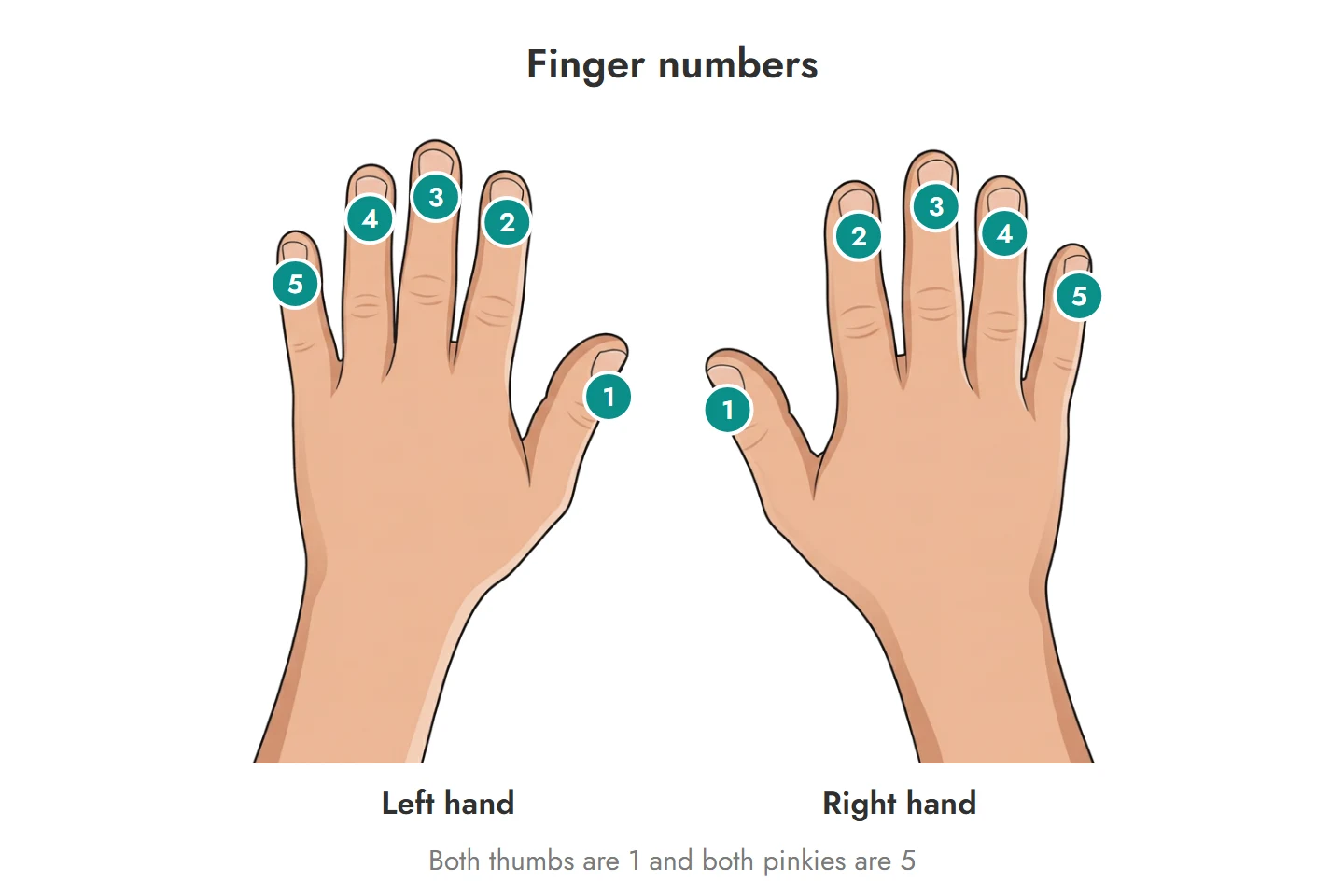
Piano notes use seven letters, A to G, and then start again. The black keys come in groups of two and three, and every C sits just to the left of a group of two. Pianists number the fingers from 1 to 5, with the thumb as 1 on both hands, and you will see those numbers in your music.
Read with landmark notes
Reading music is the skill many adults worry about most. Start with a few landmark notes and find the others from them by counting lines and spaces. Middle C sits on its own short line between the two staffs. The treble clef marks G on the second line of the top staff, and the bass clef marks F on the fourth line of the bottom staff. Get comfortable in the treble staff first, then the bass, then both. If you keep looking down and losing your place, keep your eyes on the music and find the keys by feeling for the groups of black keys. Letter names written in your music are fine for a few weeks, then let them go.

One hand at a time, then together
Playing with both hands is the part that takes the most time for nearly everyone. Learn each hand's part on its own until the notes feel sure. Then join them very slowly, as if every note were twice as long, and keep the hand that is resting loose. Try it with the three examples below, with your right thumb on middle C and your left little finger on the C below it. Play Example 1 with your right hand until it feels easy, then Example 2 with your left.


Example 3 puts the two parts together. The left hand holds long notes while the right hand moves, which is one of the first things a pianist's hands learn to do. For more steps, read How to Play Piano With Both Hands Together.

Fix the hard spot, not the whole piece
Playing a piece from the top every time means you practice the easy parts most. When a mistake happens, stop and find the measure where it starts. Play just that measure slowly, one hand at a time, then both hands. There is always a tempo slow enough to play it with no mistakes. Play it five good times in a row, and a time with a mistake does not count. Then start one measure before it, so you play into it smoothly, and bring the tempo back up a few clicks at a time. Slow and careful ends up faster.

Sleep does part of the work
Research on finger skills found that sleep helps the brain hold on to a pattern you practiced that day. So if a spot still feels shaky at the end of a practice, stop there for the day. Start tomorrow from where it felt sure, and you may find it steadier than you left it.

Learn songs you love
Tell your teacher which songs you want to play, from classical and jazz to pop, rock and musical theater. Many adults pair an adult method book, which builds reading and technique step by step, with songs they love. If a song is too hard for now, your teacher can find an arrangement at your level or save it for later. Learn the melody with your right hand, the chords with your left, then put them together slowly. Learning the chords in a key also lets you accompany your own singing.

Coming back after years away
If you took lessons as a child, more comes back than you might expect. Note names, music symbols and how to sit often return quickly, and early pieces come back with a little repetition. Reading the bass clef, scales and playing hands together usually need rebuilding. Many returning players review from the start of an adult method book and move quickly past what they already know.

Piano, digital piano or keyboard
You can start on a piano or on a keyboard on a steady stand. A modern piano has 88 keys. A digital piano has 88 keys too, weighted to feel like a piano, and it can be played through headphones, which helps when others are asleep. A smaller keyboard is fine to begin with. In online lessons, your teacher needs to see your hands. With Piano Mode in AAM Studio, a phone or tablet becomes a second camera on your hands and the keys while your main camera shows you, so your teacher sees both at once.

It always comes down to practicing
Whatever your age, it always comes down to practicing. At All Around Music we think of learning as about 80 percent practice and 20 percent instruction. The lesson's job is to give you what you need to practice well all week, with clear steps, music you enjoy, practice notes and a recording of each lesson to rewatch for 30 days. For ways to fit practice into a full week, read How to Learn an Instrument With a Busy Schedule.

Questions adults ask
Here are short answers to a few common questions.
Is 40, 50 or 60 too old to learn piano
No. Adults start piano at every age. Your brain keeps adapting to practice, and each lesson can follow your pace and goals.
How long does it take an adult to learn piano
It depends on your goals and how much you practice. A few weeks on one song is normal at first, and short, steady practice on most days keeps you moving forward.
Should I learn to read music or play by chords
Many adults learn some of each. Reading opens up written pieces, and chords let you play many songs and accompany singing. Tell your teacher which you want, and the lessons can lean that way.
Can adults learn piano online
Yes. In a live one-on-one lesson your teacher sees and hears you play, and with Piano Mode your teacher can see your hands on the keys too.
How much should an adult practice piano
Short, focused practice on most days, at a length you can keep. Tell your teacher how much time you have, so your practice list fits your week.
To meet our piano teachers and the ages and levels they teach, visit our piano page. Your first lesson has a money-back guarantee.
Sources
Wikipedia, Neuroplasticity PMC (US National Library of Medicine), Brain plasticity and motor practice in cognitive aging PubMed (US National Library of Medicine), Individualized piano instruction enhances executive functioning and working memory in older adults PMC (US National Library of Medicine), Cognitive, Motor and Social Factors of Music Instrument Training Programs for Older Adults' Improved Wellbeing PMC (US National Library of Medicine), Sleep forms memory for finger skills PMC (US National Library of Medicine), The Role of Sleep in Motor Sequence Consolidation, Stabilization Rather Than Enhancement Baylor University, Baylor Piano Basics, Fundamentals of Piano Technique Baylor University, Baylor Piano Basics, Orientation to the Keyboard Baylor University, Baylor Piano Basics, Practice Strategies Open Music Theory, The Keyboard and the Grand Staff Wikipedia, Clef Wikipedia, Staff (music) Wikipedia, C (musical note) Wikipedia, Fingering (music) Wikipedia, Piano Wikipedia, Digital piano Wikipedia, Electronic keyboard University of Nebraska-Lincoln, Large Piano Lab at GKSOM undergoes transformation