
November 20, 2026
Saxophone for Kids, What Age to Start and What to Buy
Many children start saxophone when school band begins, often in 4th to 6th grade, and the alto is the most common saxophone. Here is how to tell when your child is ready, what to buy, and what the first notes and months on saxophone look like.
What age can a child start saxophone
In the United States, many school band programs begin in 4th or 5th grade, and some in 6th, so many children pick up the saxophone at about 9 to 11. Many children start music lessons earlier, between 6 and 9, and some start saxophone at that age with a teacher's help. Readiness matters more than age, and every child is different.

Signs your child is ready
A child who is excited to play, can focus on one activity for a while and follows directions well is often ready for a first lesson. The saxophone is a fairly large instrument, so it also helps if your child can hold it comfortably with a neck strap and reach the keys. A teacher can check both at the first lesson.
A woodwind made of brass
The saxophone is a woodwind, even though its body is usually made of brass. Its sound starts at a single reed on the mouthpiece, much like a clarinet. A Belgian instrument maker, Adolphe Sax, invented it and patented it in 1846, and you can read his story in Adolphe Sax and the Story of the Saxophone. Today the saxophone plays in concert bands, marching bands, jazz, rock and pop.
Four common saxophones
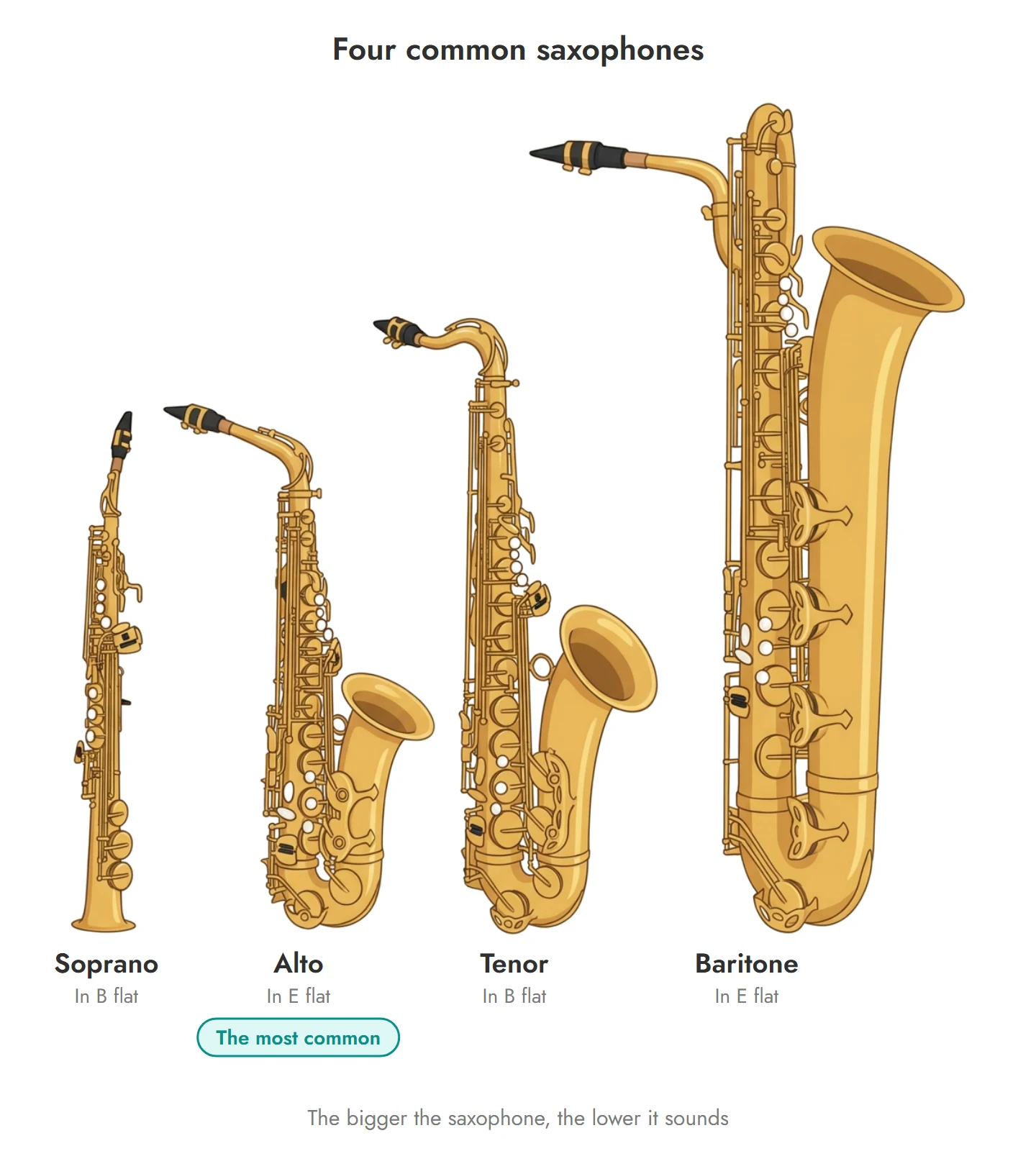
The saxophones you see most often are the soprano, alto, tenor and baritone. The soprano is the highest and the baritone the lowest, and the alto, pitched in E flat, is the most common. At All Around Music we find the alto suits most beginners.
The parts of a saxophone
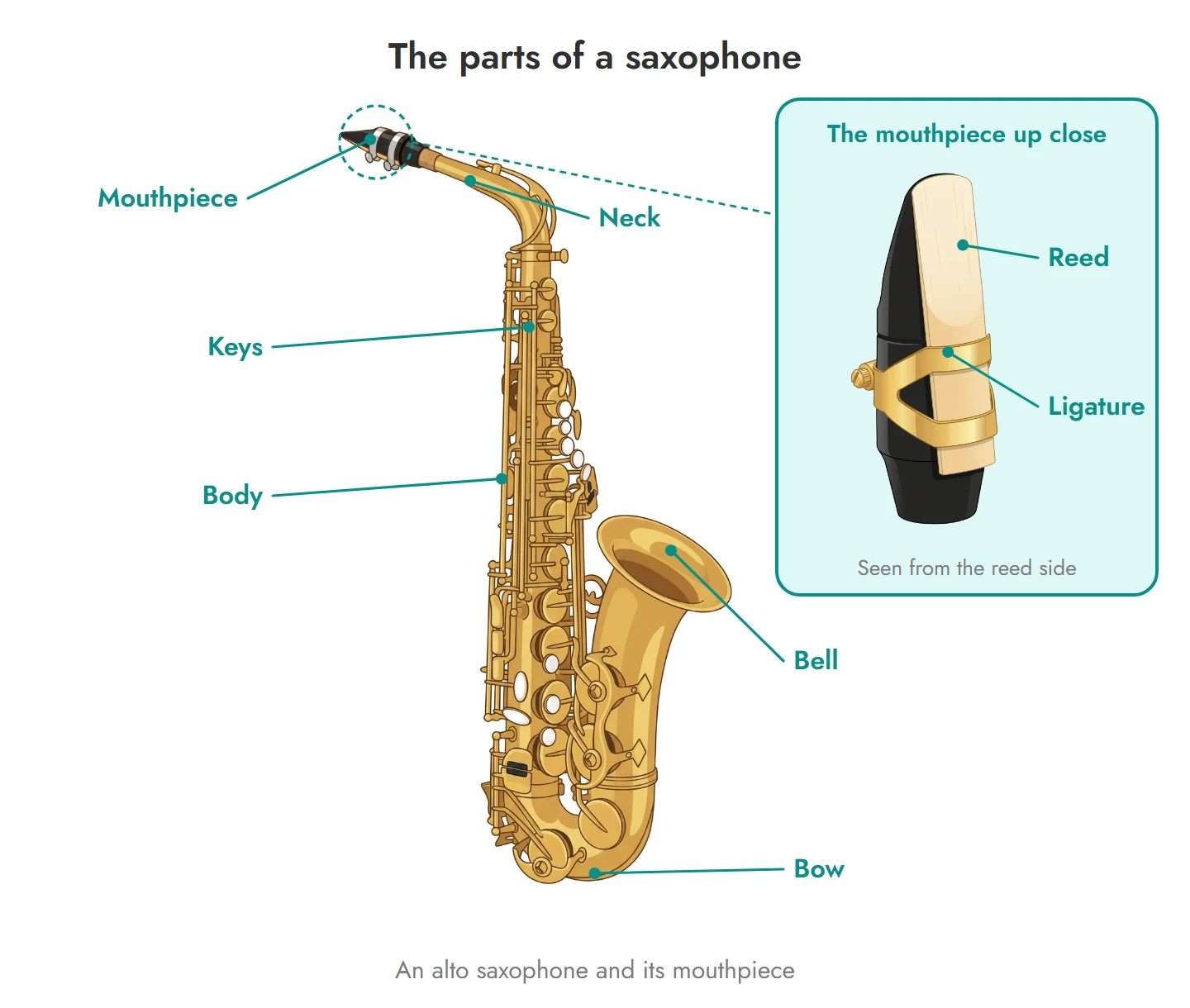
Knowing the parts makes the first lessons easier to follow. The ligature holds the reed on the mouthpiece, and the mouthpiece fits onto the cork at the end of the neck. The neck joins the body, where the keys open and close the holes. At the bottom, the bow turns the tube back up to the bell.
Reeds
A reed is a thin piece of cane, or of a synthetic material, that vibrates against the mouthpiece when you blow. Reeds are numbered by strength, usually from 1 for the softest to 5 for the hardest, and the numbers are not exactly the same from brand to brand. Ask the teacher which strength to buy, and keep a few reeds in a reed holder so a good one is always ready.
Putting it together
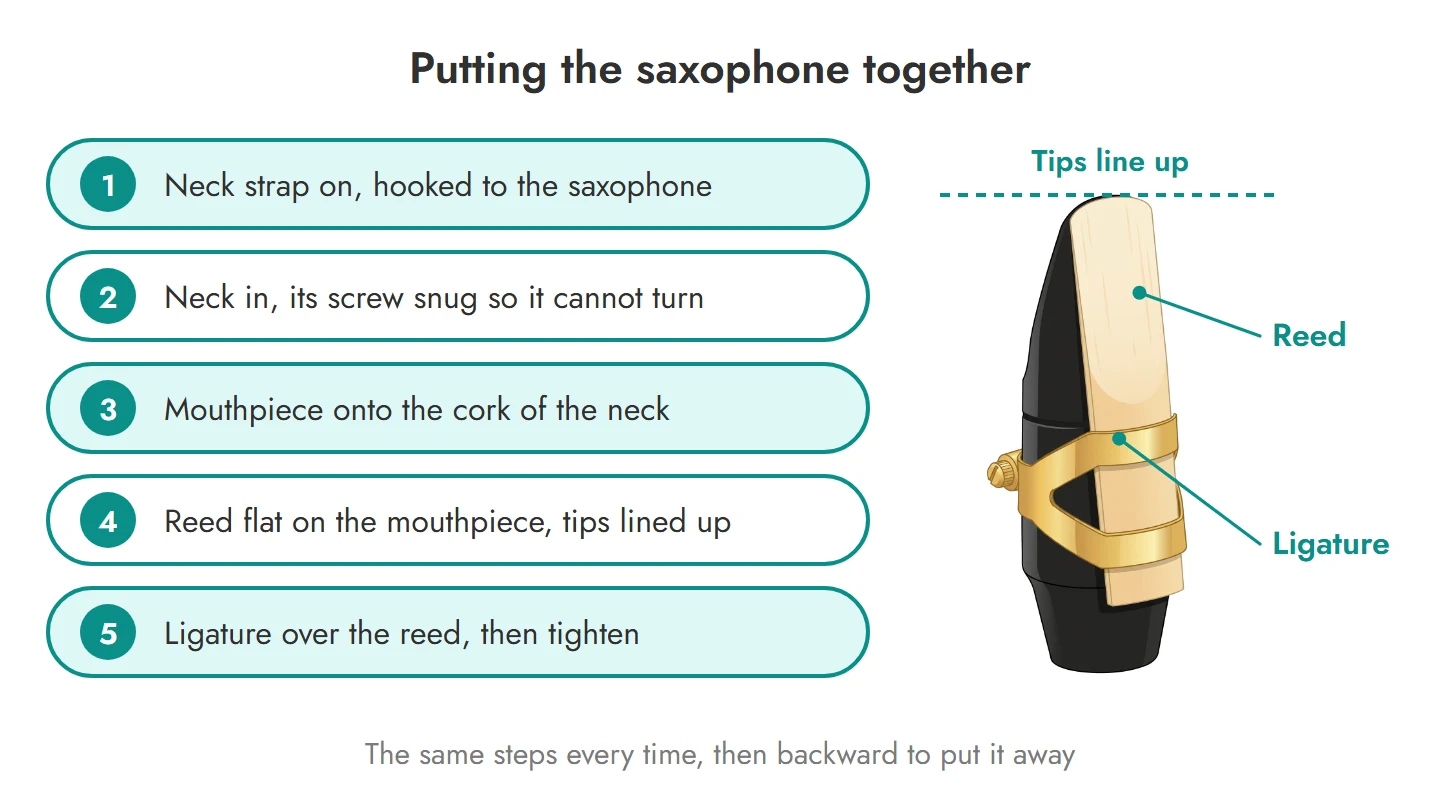
Putting the saxophone together the same way every time keeps it safe, and practicing the steps at home makes the first lessons easier. Line up the tip of the reed with the tip of the mouthpiece, and tighten the neck screw until the neck is snug and cannot turn. To put it away, follow the same steps backward.
Holding the saxophone
The neck strap holds the saxophone at your child's right side, with the left hand on top and the right hand below. The left thumb rests on the thumb rest at the back, next to the octave key. Keep the fingers off the other keys, since pressing one by accident can stop a note from sounding. Do not rest the saxophone on the leg, because it can close a key and change the note.
Mouth shape
The way the mouth holds the mouthpiece is called the embouchure. The bottom lip curls a little over the bottom teeth, the top teeth rest gently on top of the mouthpiece, and the corners of the mouth stay firm so no air leaks out. Try not to bite, since biting keeps the reed from vibrating and the sound can cut out.

A low, steady breath
A deep, low breath gives a full sound. Breathe in so the stomach rises while the chest stays still, and lie on the floor to see which one moves. Two warm-ups build steady air. Play the mouthpiece alone for 4 seconds and rest for 4, keeping the mouth in the same shape while you rest. Then hold a long B for as long as you can, rest about 4 seconds and play it again. Low notes need even more air and a more open space at the back of the mouth.

Starting each note
The tongue starts each note. The tip of the tongue touches the tip of the reed and lets go, as if saying ta, while the air keeps flowing. Try ta rather than a soft who, which leaves the start of the note unclear. Under a slur, the curved line over a group of notes, only the first note gets ta and the fingers change the rest.

First notes, B, A, G and C
Four first notes use the left hand alone. B is the first finger of the left hand, A adds the second finger, and G adds the third. C uses only the second finger. None of these four notes needs the octave key or the right hand, and changing between them slowly, one note at a time, helps the fingers find their places.

A first song
Hot Cross Buns is a traditional English rhyme first printed in the 1700s, so it is in the public domain. In this version it uses only B, A and G. Play it slowly with a metronome, hold each buns for two beats, and keep each note right on the click without rushing.

After playing
Take the reed off the mouthpiece, let it dry and store it in its holder, since a reed left on a wet mouthpiece can grow mold. Pull a swab through the body to dry the inside, dry the neck, and put everything back in the case.

What your child needs
To start, your child needs an alto saxophone with its case, a mouthpiece and ligature, a few reeds with a reed holder, a neck strap and a swab. If you are not sure which saxophone or reeds to buy, ask the teacher first.
How long should the first lessons be
Short lessons suit young beginners. A 30 minute lesson keeps new and younger students focused. As your child grows, a 45 minute lesson leaves room for more pieces and feedback, and an hour gives advanced students time to refine technique and prepare for auditions.
It always comes down to practicing
However your child takes lessons, it always comes down to practicing. At All Around Music we believe most of a child's progress comes from practicing at home, and we think of learning as about 80 percent practice and 20 percent instruction. The lesson's job is to give your child everything they need to practice saxophone well all week, with clear steps, music they enjoy and practice notes to follow at home.

Simple practice at home
Short practice on most days works well for young players. Start with at least three warm-ups, slowly and with full air. Then play the song from the practice notes with a metronome, counting out loud, and finish with a song your child enjoys. Putting the saxophone together and away counts as practice too.
What the first months look like
Every child learns at their own pace, but the path usually follows the same steps. First comes putting the saxophone together, breathing, mouth shape and first notes with a clear tone. Next come tone, reading music, scales and music theory. Later a player can go further with concert band and jazz music, improvisation, and preparing for performances and school band.

Questions families ask
Here are short answers to a few common questions.
Is 7 too young for saxophone
Not always. Some children start younger, and a teacher can check whether your child can hold the saxophone comfortably and reach the keys. If your child is not quite ready, singing, clapping and listening to saxophone music together are a great start.
Should my child start on alto or tenor
The alto is the most common saxophone and is smaller than the tenor. Ask the teacher which one fits your child before buying.
Do we need a saxophone before the first lesson
It helps to have one at home, so your child can practice between lessons. For lessons with All Around Music, your child needs a saxophone, a mouthpiece and ligature, a few reeds and a neck strap.
Is it too late to start saxophone at 12 or as a teen
No. Older beginners can usually focus for longer, which helps in the first lessons, and teens and adults start saxophone too.
Can a child learn saxophone online
Yes. In a live one-on-one lesson the teacher sees and hears your child and can guide each step, while your child plays at home on their own saxophone. Set up the camera so the teacher can see the whole saxophone, your child's posture and mouth shape. Read more in Are Online Music Lessons Good for Kids?
At All Around Music, our saxophone lessons are open to all ages. Each teacher's card on our band page shows the instruments and ages they teach, so you can choose the right teacher for your child.
Sources
PBS KIDS for Parents, What's the Right Age to Begin Music Lessons? National Association for Music Education (NAfME), National Opportunity to Learn Standards Wikipedia, School band Wikipedia, Attention span Wikipedia, Saxophone Encyclopaedia Britannica, Saxophone Wikipedia, Alto saxophone Britannica Kids, Saxophone Wikipedia, Adolphe Sax Encyclopaedia Britannica, Adolphe Sax PBS, TSO Symphonic Safari Adventure, Saxophone, Meet Geoff the Saxophonist PBS, Sound Field, How the 80s Almost Killed the Saxophone Wikipedia, Ligature (instrument) Wikipedia, Register key Bluffton University, Woodwind Doubling Resource Project, Fingering Systems Wikipedia, Reed (mouthpiece) University of Iowa Saxophone Studio, Who Wants to Talk About Reeds? Western Kentucky University, Saxophone Basics Wikipedia, Saxophone technique Bluffton University, Woodwind Doubling Resource Project, Articulation Western Kentucky University, Saxophone Harmonics University of New South Wales, Acoustics of the Saxophone, fingerings for B4, A4, G4 and C5 Wikipedia, Hot Cross Buns (song) Villanova University Falvey Library, Hot Cross Buns, A Lenten Treat Wikipedia, Public domain in the United States Florida International University Bands, Instrument Maintenance Handouts Cal Poly San Luis Obispo University Bands, Instrument Hygiene Saxophone pictures redrawn from the photo Eight saxophone sizes by Jonathanischoice, Wikimedia Commons, CC BY 4.0 Mouthpiece picture redrawn from the photo Bec de saxophone by Nicolas Buffler, Wikimedia Commons, CC BY 2.0